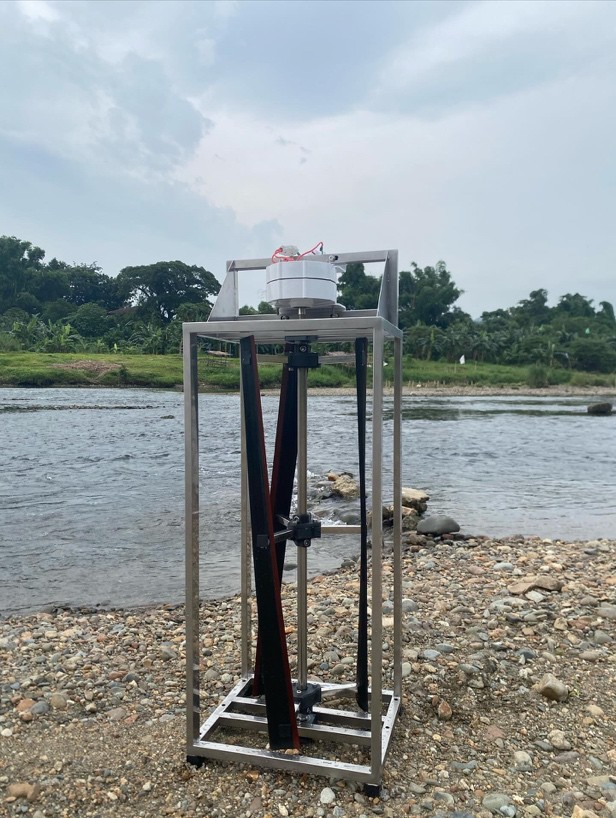
Back in February 2026, Power Philippines reported that a young Filipino startup called Saltric had a river turbine that could make "up to 500 watts of continuous electricity as long as the current flows". It's the Marissa Turbine, built by founder Patrick De Guzman, who is also studying law. The company says it's been more than a decade in the making, with five design versions and "hundreds of thousands of pesos" spent on development. That's nine months ago now, so we've gone back over what's actually been shown.
What's been tested. Two river trials are described. The first was in the Meycauayan River at Obando, Bulacan, with SM Cares and the Global Peace Foundation, where local fishers reportedly used the power for night fishing lights and ice storage. The second was an Angat River prototype, funded by the Department of Science and Technology with technical help from UP Los Baños. Power Philippines says it "successfully powered two households", running laptops, phones and electric fans from river flow alone. That's a real, working result for a backyard-scale machine, and it's the part of the story that checks out.
What hasn't been shown. Neither trial comes with a measured output. The 500-watt figure is a rating ("could generate", in the Intellectual Property Office of the Philippines write-up), not a logged result, and no river speed, rotor size or running time is published. Think of it like a diesel engine sold on its brochure kilowatts with no dyno sheet. It might well be right, but nobody outside the company has seen the curve. The IPOPHL piece lists a price of ₱150,000 a unit, which works out to ₱300 for each rated watt, and Power Philippines doesn't give a price at all.
The rollout numbers don't add up. The company plans 180 units in Northern Luzon, and a total of 500 kilowatts over five years. At 500 watts each, 180 units come to 90 kilowatts, not 500. Either the five-year plan covers many more units than the first 180 or one of the figures is off, and neither report explains which. A street-lighting pilot in Catbalogan City, Samar, is described as under consideration only. We couldn't find a published update on the 180-unit rollout or the Catbalogan pilot since February.
Why it's still worth watching. The blades are 3D printed from strips of used plastic bottles, the frame is corrosion-resistant steel, and the design is protected as a utility model and industrial design. IPOPHL says Saltric won the top professional-category award at the 2025 Socially Relevant Technologies contest, and it reports earlier awards in 2024. Those are recognition for the idea, not independent power measurements. Two households is a promising start. A logged week of output from the Angat unit would settle most of the questions.