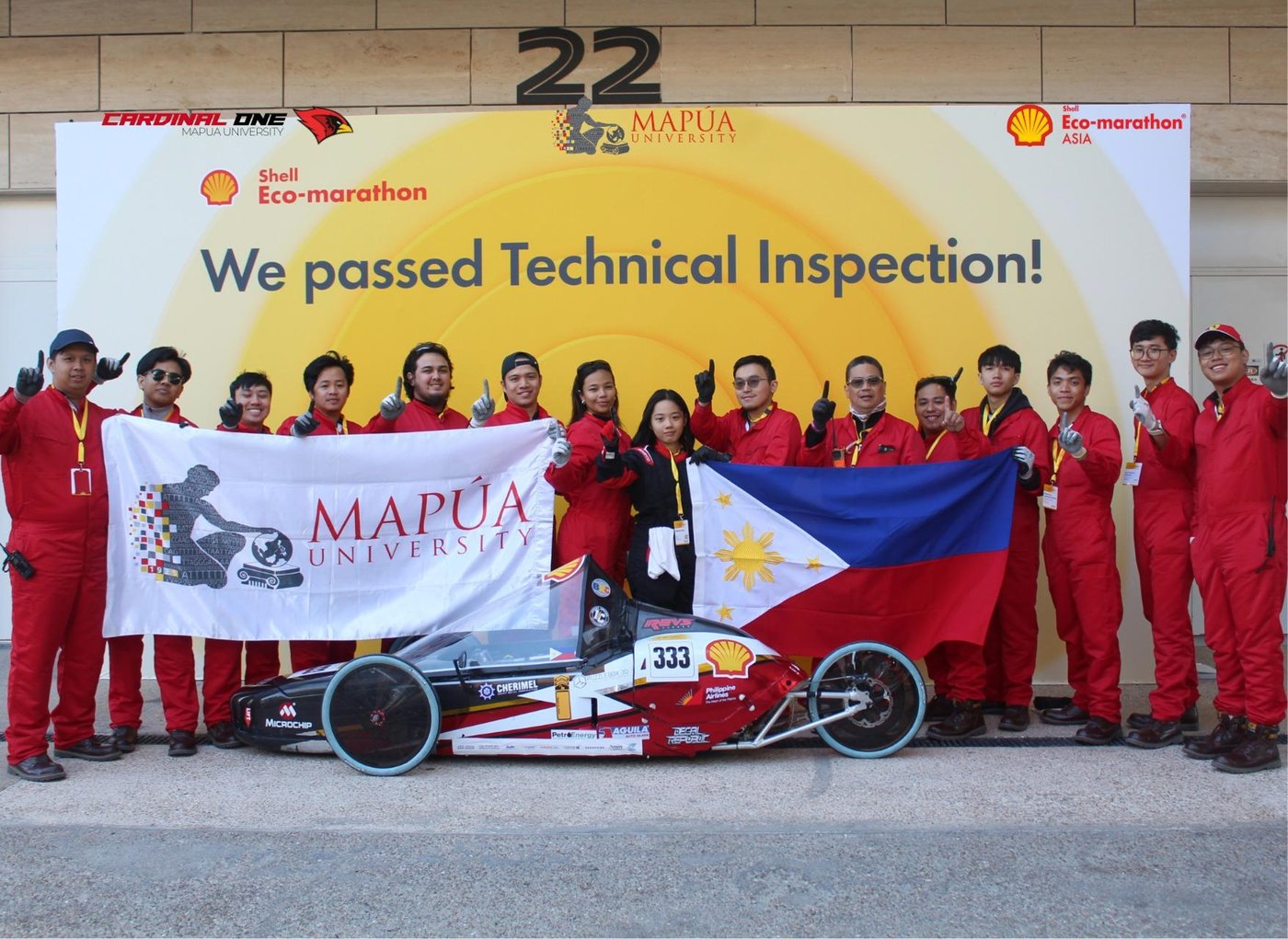
The claim comes from Mapúa University's student engineering team, Cardinal One, which took its first battery-electric prototype, the Aguila Neo Electric, to the Shell Eco-marathon Asia-Pacific and Middle East event at Lusail International Circuit in Qatar from 21 to 25 January 2026. GMA News reported on 11 February that it passed technical and safety inspection and logged an initial 91 kilometres per kilowatt-hour. That's now nearly ten months ago, and this is the story as it stood then.
What checks out. The organiser's team page lists Cardinal One (car 333) as passing all 10 inspection sections, covering things like brakes, driver safety, electrical design and energy verification. It also shows a best valid run of 91.0 km/kWh, with a second valid run at 89.4. GMA says this is the team's first battery-electric entry after 15 years of internal-combustion prototypes, according to its July 2025 launch report. For a student team switching technology, getting through a full electrical inspection is real work.
Where 'made history' wobbles. The same page ranks Cardinal One 16th of 19 in the battery-electric prototype class, so it wasn't a contender for the podium. The team ahead of it at 15th did 99.2 km/kWh and the one behind did 87.7. Four of its six runs were marked invalid. The 'only Philippine team' line holds for that class, but the event also had two Philippine petrol-class entries, including Mapúa Malayan Colleges Mindanao's AME Merlin, which finished 8th in its class. And a global-qualification table on Shell's full results page shows Cardinal One at an 'average efficiency result' of 60.11, a number that doesn't match 91.0 and isn't explained, so we couldn't reconcile the two.
What hasn't been tested. The organiser's team page itself says the data hasn't been formally verified. No test conditions, battery size or build cost has been published, and no figure shows how 91 km/kWh would hold up on a normal road with traffic and hills. Eco-marathon runs are about squeezing the most out of every watt-hour on a closed circuit, a bit like a fuel-economy run on a test track versus a loaded truck on a highway. A July 2025 report also credited the team with a chassis and shell '50% lighter than previous models', which is the team's own claim.
Since then. We couldn't find any published follow-up, such as a rebuild, new results or plans for the next event. If the team does return, the thing to look for is whether the invalid runs turn into valid ones, because that's where most of the distance to the front was lost. For a student crew with a first electric build, it's a solid start that's been described a little bigger than it was.