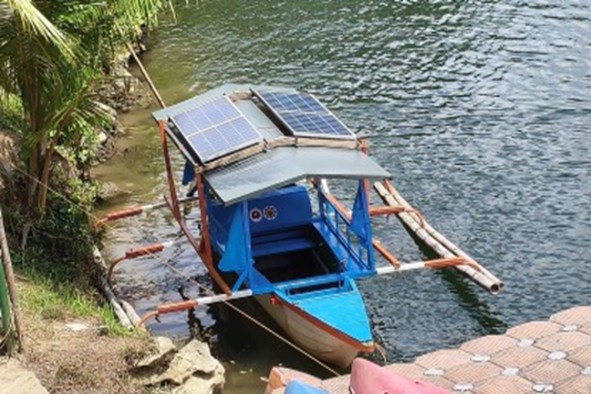
This one dates from April 2026, about six and a half months ago. Four graduating electrical engineering students from Eastern Visayas State University (EVSU) in Tacloban, Antonio Adorza Jr., Mac Jandy Guintadcan, Brian Jeffrey Reyno and Richard Reynada, built a solar electric pump boat for tourist trips at Sohoton, Basey, in Samar. It was handed to a community group, the Sohoton Services Cooperative, around 18 April 2026, and the story went out through News Philippines Online (which carried a PNA-PR credit), the Manila Bulletin and a few regional sites.
What's actually on the boat. The reports agree on the kit: four 100-watt solar panels, a 48-volt battery system and a 1,500-watt motor. The student team put the cost at about ₱40,000. The Manila Bulletin says the boat is already carrying tourists on the Cadac-an River, and the photo shows exactly that: a traditional outrigger hull with a little roof carrying two panels. The panels in the picture are what the reports describe. For a four-student project built over roughly six months, that's a real, working boat and not just a design on paper.
What the numbers leave out. Four 100-watt panels make 400 watts at best, in full sun. A 1,500-watt motor working flat out wants almost four times that, so the battery does most of the lifting, and nobody has published how big it is. Think of a tractor with the fuel tank size missing from the spec sheet. There's no range, speed, passenger load or charging time in any report we found, and the Manila Bulletin says outright that the runtime on a full charge "has not been specified". The line that it "works" rests on the boat being in use, not on test figures.
The fuel claim. Reyno says the boat needs no fuel and is quiet, and the cooperative's Beatriz Boleche told reporters that with fuel prices rising, going solar cuts their reliance on petrol. Both are fair on the face of it, since sunlight costs nothing. But no one has put a figure on how much petrol the cooperative used to burn or how many trips a charge covers, so the saving is a reasonable expectation, not a measured result. A local electrical engineers' chapter reportedly checked the design against the Philippine Electrical Code, which is a good sign for safety, though we only have that from one report.
What's happened since. We couldn't find any follow-up reports since April, no trip logs and no word on whether the cooperative is still running it. EVSU's engineering dean, Vinyl Oquiño, said the school wants to present the project at research forums and seek support from agencies like DOST. If that happens, a range test on the water would be the number worth waiting for. Verdict: it checks out as a real working prototype, but the performance claims aren't proven yet.