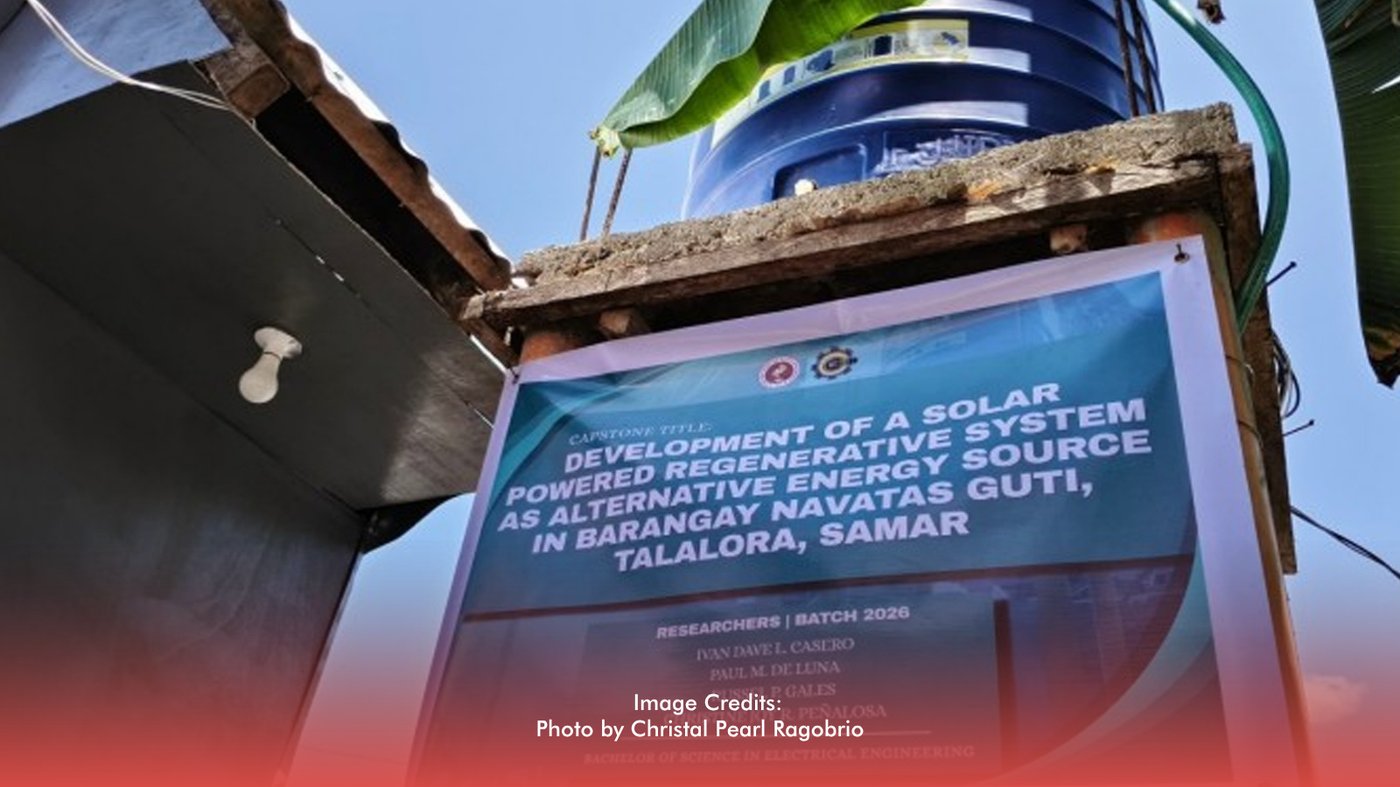
This one's from the files: it was reported in April 2026, and we couldn't find a follow-up. Graduating electrical engineering students at Eastern Visayas State University (EVSU) in Tacloban built a capstone project called "Development of a Solar Powered Regenerative System as Alternative Energy Source" for Barangay Navatas Guti in Talalora, Samar. Dito sa Pilipinas, which reported it on 29 April 2026, says it supplies 2,880 watts to the village hall and 16 streetlights, for more than 1,000 residents. It cost about ₱170,000, paid for by student contributions and local government support.
How it's meant to work. Solar panels run a submersible pump that lifts water from a deep well into an elevated tank. At night, or when the sun's weak, the stored water drops back through a turbine and generator. It's a mini version of pumped hydro, and it doesn't rely on a river. The photo backs up the basics: it shows the project banner, with the students' names, strapped to a post under a blue water tank, and a bare light bulb on the wall beside it. The village council has reportedly committed around 20 percent of its annual budget to maintenance, which is a good sign for a project like this.
The sums are the hard part. The report doesn't give the tank size, the height it sits at, or what the lamps draw. So here's our own rough check, using assumed numbers. Lift 1,000 litres of water 5 metres and you store about 14 watt-hours. Sixteen LED streetlights at 20 watts each, running 10 hours, need around 3,200 watt-hours. Even 10,000 litres lifted 10 metres only stores about 136. Think of it like a jerry can on a shelf trying to run a workshop light all night. Gravity storage needs a lot of water or a lot of height. The students may well have a bigger setup than we've assumed, or the solar panels may carry most of the load. The report doesn't say.
What hasn't been tested. The article says the system "currently supplies" the hall and lights, but it gives no measurements or run times. It doesn't say whether 2,880 watts is the panel size, the inverter size or the output, or how long the lights stay on after dark. Nothing about the project has been independently checked, and the claim rests on one news report. The benefits it lists, like better night lighting, are reported by the outlet and weren't measured. We also couldn't find an update on how it's holding up since April.
Why it still matters. This is four students and a village putting real equipment in the ground for about the price of a second-hand ute, and handing it over to a council that's promised to look after it. That's worth backing. What would make it a clear pass is simple: a tank volume, a pump and turbine rating, a night-time run time, and a few months of the lights actually staying on.