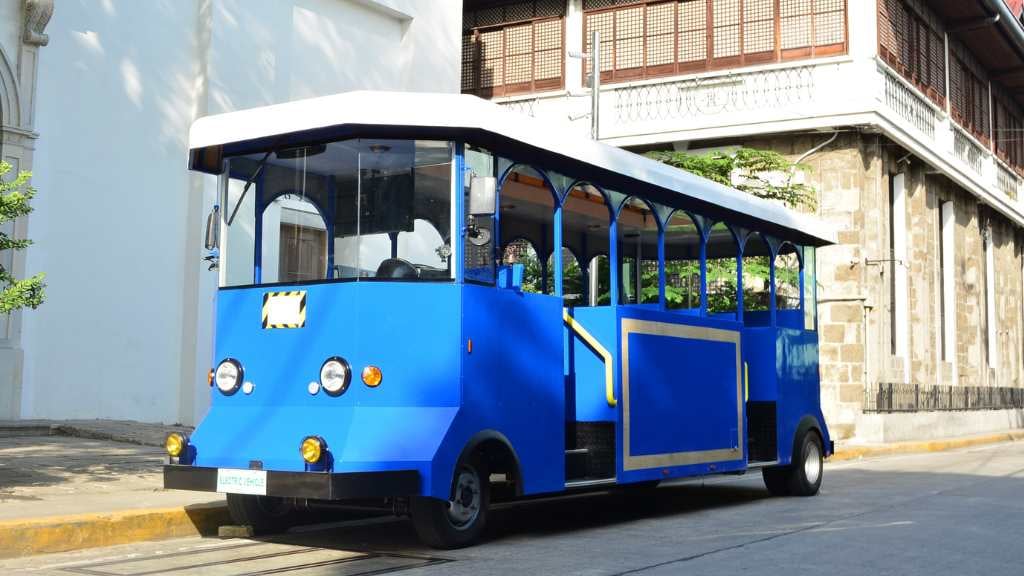
This one dates from March 2026, so it isn't fresh news, but it's a good look at what happened next. On Thursday 19 March the Department of Science and Technology (DOST) handed the Intramuros Administration its first locally developed electric tranvia, an 18-seater built to carry tourists round Manila's walled city. The claim is simple: Filipino engineers designed and built an all-electric tram, and it works as a replacement for the diesel ones.
Who built it checks out. Top Gear Philippines, citing the DOST, says Cagayan State University did the concept, steel frame, suspension and body, using locally made abaca-fibre composite panels. The University of the Philippines Diliman did the electrics: a lithium-ion battery, motor, controller and charger. DOST-NCR and its Industrial Technology Development Institute backed it. The Daily Tribune reports a 96-volt, 10-kilowatt powertrain, and says the structure was checked with 3D modelling and finite element analysis, which is a computer test of how a frame flexes under load. That's the designers' own word on the design work, not a published road test.
Is it actually running? It was. A pilot run took place at Plaza Roma on 22 March, and on 21 April both the Manila Times and Interaksyon reported free rides back on, twice a day, 9am to 10am and 3pm to 4pm, from Plaza Roma, with up to 18 passengers first-come, first-served and ten stops including Fort Santiago and Plaza Espana. The Intramuros Administration wouldn't say how long the free rides would last. Before this, rides in the older diesel trams cost P350 for an Intramuros passport, and the tranvia could be hired for P1,200 to P8,000 in 2024, according to Interaksyon.
What hasn't been tested, or at least published. We found no battery capacity, no range per charge, no charging time, no build cost in pesos and no running-cost comparison with the diesel trams. DOST Secretary Renato Solidum Jr. said the charging is solar, and that running an EV costs less than diesel, but those are his statements, not measured results. The administrator said she hopes budget will be released for three more units, and reports mention one more for Malacanang. We couldn't confirm any of those arrived. We also couldn't find a report after April, so we can't say how it's holding up through the wet season.
Why it still counts. A slow tourist tram on a short loop is a forgiving job for a first electric build, and it's the kind of thing a university workshop can do well. It's seen service, it's been reported by several outlets, and the people who built it are named. If the next three units get built, the numbers that matter are range per charge, what a unit costs, and how the abaca panels stand up to the sun and rain. That's what to ask for.