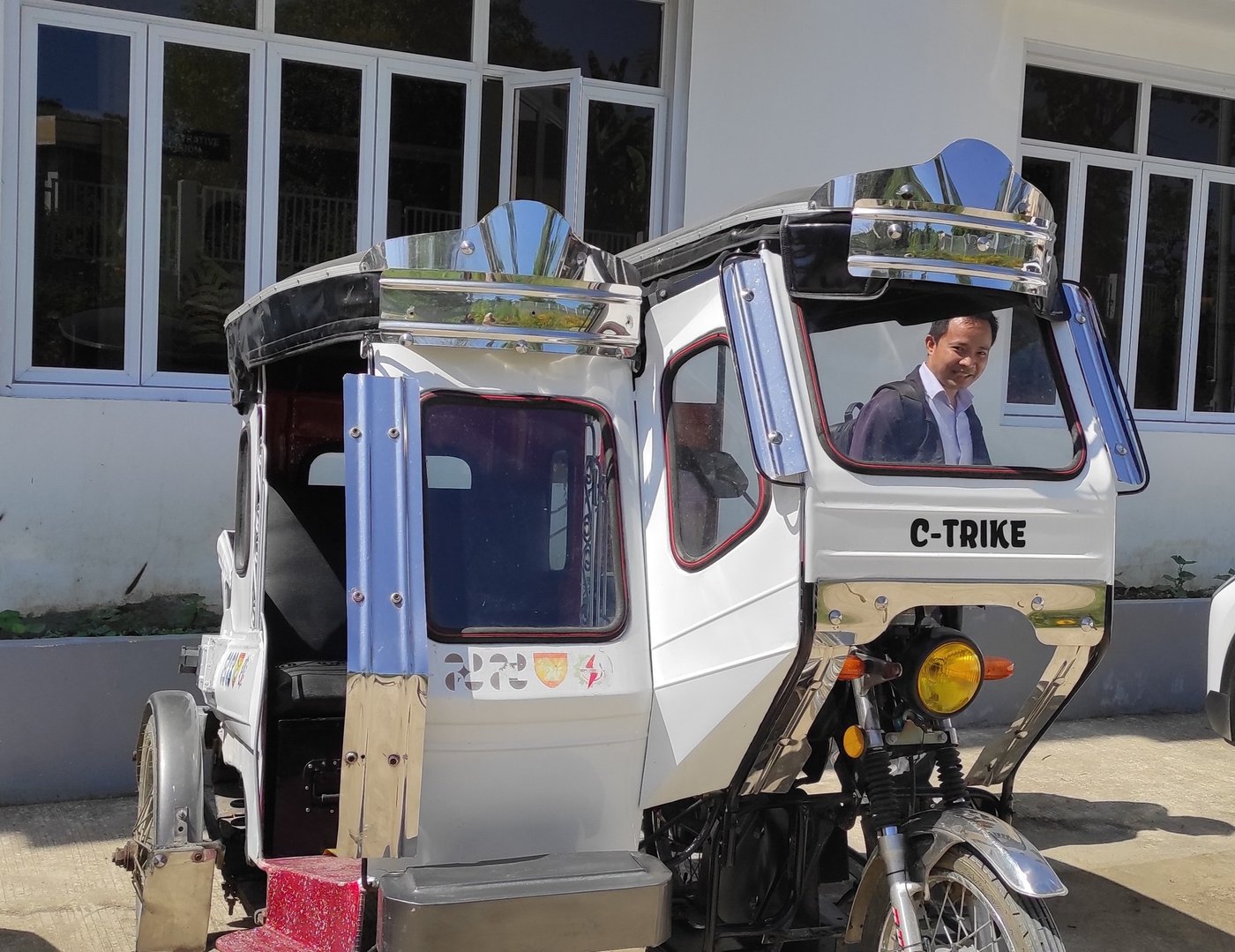
The C-Trike was put on show at the 2025 National Science and Technology Week in Laoag City, Ilocos Norte, in November 2025, and that's when CleanTechnica reported its figures. The claim comes from Cagayan State University's ElectroMobility Research and Development Center, working with the Department of Science and Technology and the University of the Philippines Diliman. It says an ordinary petrol tricycle can be converted to fully electric, with a range of up to 80 kilometres a charge and a battery that fills in 35 minutes. Running cost is put at ₱0.88 a kilometre, against ₱3.20 for a two-stroke and ₱2.30 for a four-stroke.
What checks out. The vehicle and the program are real. CleanTechnica says the wider e-mobility project has ₱79.4 million in funding, that the university signed licensing agreements with manufacturers, and that it had four technology adopters by March 2025, in Isabela, Cebu and Pasay. The photo above shows a finished C-Trike, with the usual stainless trim and sidecar body, so it looks like the tricycles drivers already know.
What's happened since. A Manila Bulletin report on 3 May 2026 describes a C-Trike unveiled in Dipolog City by the DOST and the Dipolog School of Fisheries, a TESDA-recognised school. A driver there, Arvin Almirol, got a conversion kit in June 2025 and converted his own petrol tricycle. The report says his power cost came to ₱27 for a day's operation last year and ₱40 during a fuel-price spike, and that he saves hundreds of pesos a day. At the research rate, ₱27 buys roughly 31 kilometres, though the report doesn't say how far he drives. It also says the school is slated to become the first certified conversion kit developer in Mindanao. That's one report with no named reporter and no quoted source, so treat it as encouraging rather than proven.
What hasn't been tested in public. The 80-kilometre range and ₱0.88 a kilometre are the research team's figures, and we found no independent test of them with a loaded trike on a hilly route. Neither report gives a conversion price or a battery size. CleanTechnica notes batteries make up 40 to 60 percent of the cost of a light electric vehicle, so the price will decide whether a driver can afford it. Tuguegarao also still needs a local ordinance before converted trikes can run there legally, and we couldn't find an update on that.
The verdict. It's a genuine, homegrown conversion that's already earning its keep with at least one driver. It earns Partly True because the best numbers are unaudited and the one thing a driver most wants to know, what it costs to convert, isn't published.