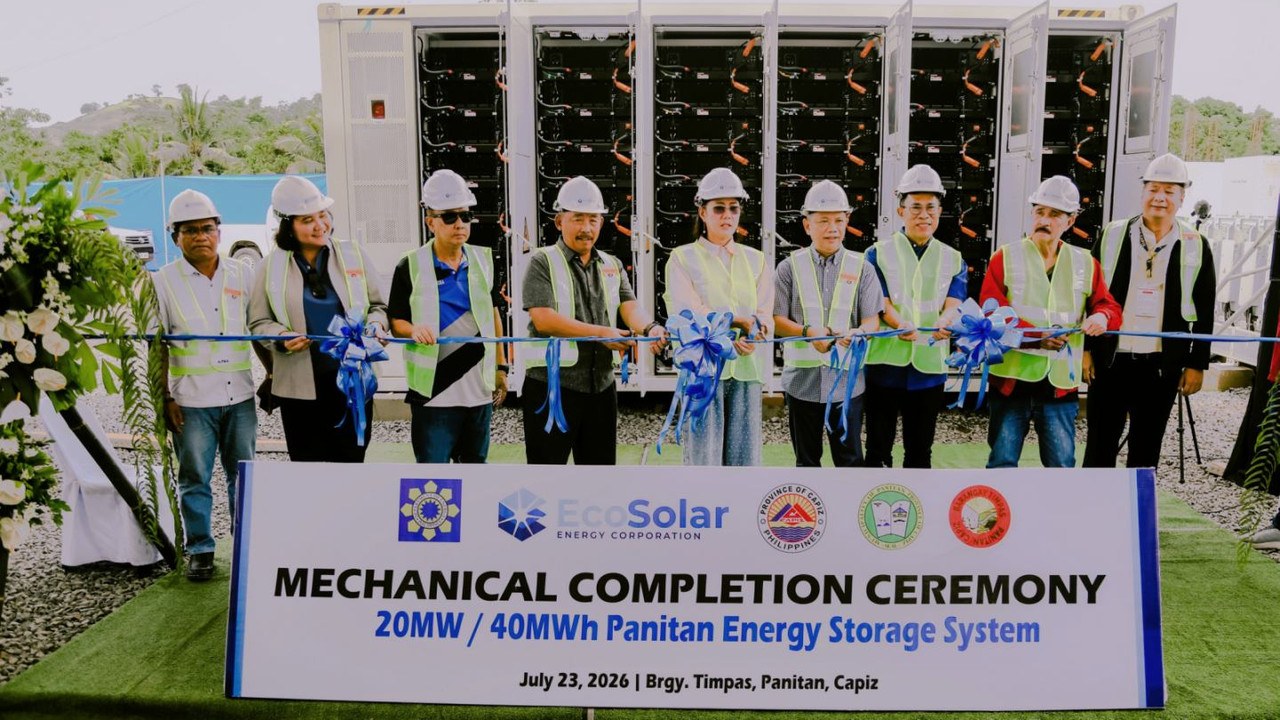
The claim comes from the company behind it. EcoSolar Energy Corporation, a Yuchengco-led unit of PetroEnergy Resources, says its battery in Barangay Timpas, Panitan, Capiz, has been energised and began testing on 5 November 2026, reported by Power Philippines on 10 November. It's the first big battery in Capiz, and a real, built thing: PetroEnergy held a mechanical completion ceremony at the site on 23 July, and the photo above is from that day.
The size has moved. In July, the company, the Daily Tribune and Huawei all called it a 20 MW / 40 MWh system. The November report says 22.5 MW / 45 MWh, which is 12.5 per cent bigger on both counts. Either way it's a two-hour battery, meaning it can run flat out for about two hours. None of the reports says what the 20 or the 22.5 is measured on, and none explains the change. The November report says it comes from a company disclosure dated 10 November. We couldn't find that filing on PetroEnergy's public filings page, which listed nothing after 9 November, so that number rests on one outlet's account for now.
Energised isn't the same as supplying. The reports say the National Grid Corporation of the Philippines has issued a provisional certificate to connect, and the market operator has approved its registration. Full operation still depends on the remaining tests. The battery is billed as grid-forming, which is the type that can help hold the network steady rather than just follow it, and PetroEnergy says it's the first in the country to use Huawei's LUNA2000-5015-2S units. Both the grid-forming role and the "first" are the company's own claims, and nobody has published test results showing what it does on the Panay-Guimaras-Negros grid. One trade site headlined it as the Philippines' first battery storage project, but its own text only says first in Capiz, and the Philippines has had grid batteries for years.
What hasn't been tested, and the money. The ₱635.9-million figure is the RCBC loan for the battery, not a stated total cost. The solar farm that's meant to go with it, 90 MWdc, isn't targeted to feed the grid until mid-2028. In July the company said the whole battery would be completed in the fourth quarter of 2026, so the testing is on schedule by its own timeline. Whether it eases the reserve shortages and supply interruptions the Visayas keeps having will only show once it runs on the live network. Treat the 22.5 MW as unconfirmed until the filing turns up.