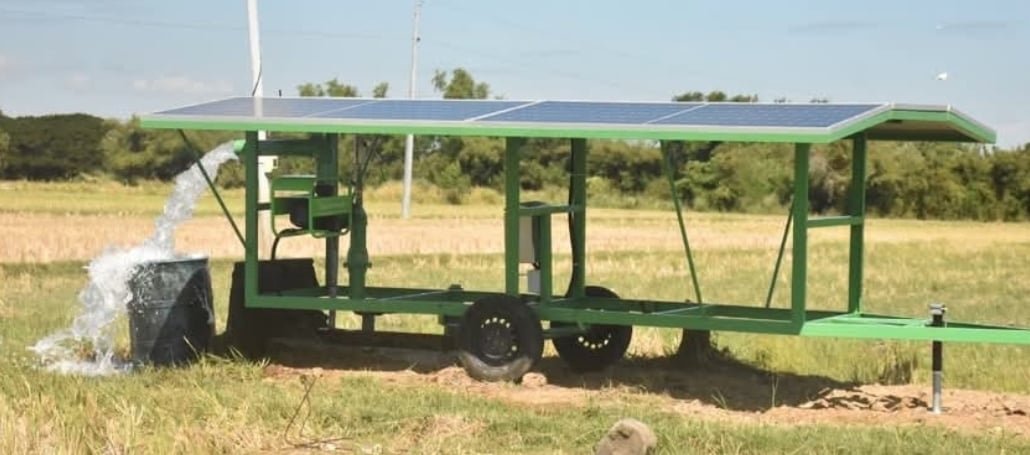
The claim comes from the Department of Science and Technology's Calabarzon office. It says a mobile solar-powered irrigation system was put to work on 17 November 2026 in Barangay Balagbag, San Juan, Batangas, to serve 19 members of the Batangas Rice Federation, known as BARIFED, on about 28 hectares of rice. The pump is a collapsible rig developed by Batangas State University, The National Engineering University, and it runs on sun instead of fuel. It's a small government and university project, not a commercial one, and the Daily Tribune photo shows it standing in a paddy with water coming out of the pipe.
What's real. The deployment itself is reported in a Daily Tribune story filed the same day, with a caption saying the rig was demonstrating its pumping in a rice field. DOST, through its CEST program, allocated ₱538,500 to support the federation, and the setup, panels included, is put at about ₱390,000. That ₱390,000 is labelled an estimate and the report doesn't say who worked it out. The rig first went to the farm of BARIFED president Ronelo A. Garcia and will be shared on a rotation, with priority for farms short of water and rice at critical growth stages. Think of it like a shared workshop compressor on a trailer, towed to whoever needs it that week.
What's missing. There's no kilowatt rating for the panels or the pump anywhere in the report, and no litres per hour or hours of pumping a day. Without those, 28 hectares is a promise about coverage, not a measured result. The line that the system "could reduce recurring irrigation expenses" is a projection too. No fuel bills before and after have been published, and the 19 farmers and 28 hectares are described as who it is "set to" serve, not as results.
The fertiliser add-on. The same project hands out a plant growth promoter called C-PGP, developed by the Philippine Nuclear Research Institute and supplied through VVZ Corporation at ₱550 a litre. The report says it's designed to improve plant vigour and crop tolerance, but it cites no trial or result. That's a separate claim from the pump and hasn't been tested in anything we've seen. The effort sits under DOST's Project PALAY, with training for the farmers on top.
What to watch. Does the pump keep up when water is really short, and does the rotation hold up when every farm wants it in the same week? With El Niño worries in the air, that's the real test, and it's one we couldn't find a result for yet. This is a single report from the Daily Tribune, and we haven't found DOST's own release or any independent check. The idea is sound, since sun and a pump are a good match when the dry season is when you need the water most, but the numbers aren't there to prove the savings.