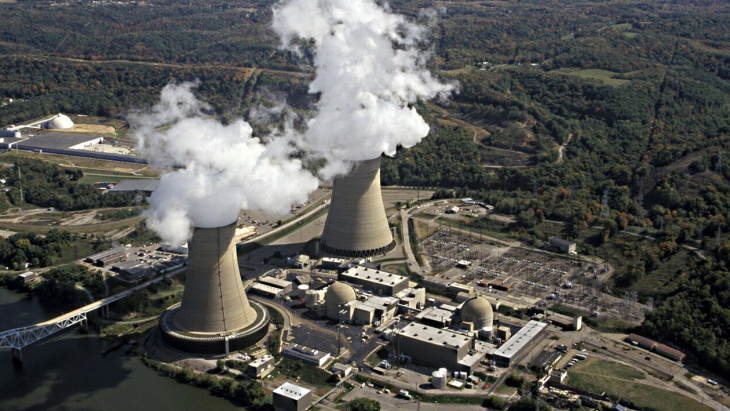
The claim going around since Monday is that Washington is handing a power company billions of dollars to expand nuclear energy for the whole country, 3 million homes' worth, as the Department of Energy tells it. The dollar figure and the megawatts are genuine. On 5 October 2026, the DOE's Office of Energy Dominance Financing offered Vistra Corp a conditional loan commitment of up to $4.2 billion, confirmed in matching detail by World Nuclear News, Utility Dive and Power Magazine. What most of that coverage leaves out is who already owns the power this loan actually creates.
What the loan covers. The money is earmarked for uprates (equipment upgrades that squeeze more output from an existing reactor, not a new plant) at three Vistra sites: Beaver Valley in Pennsylvania, and Davis-Besse and Perry in Ohio, with an option to extend to Comanche Peak in Texas later. Together the three Ohio and Pennsylvania uprates add 433 megawatts of new capacity and, DOE says, preserve nearly 4 gigawatts of existing baseload for 20 years beyond the plants' current licences, enough, by DOE's own maths, to power more than 3 million homes. Energy Secretary Chris Wright called it delivering on "an American nuclear renaissance." The loan is conditional: Vistra still has to clear technical, legal, environmental and financial hurdles before any money changes hands, and it is a loan Vistra must repay, not a grant.
The part the press release doesn't say. Back in January 2026, Vistra signed a 20-year power purchase agreement with Meta covering roughly 2.6 gigawatts, to run its AI data centres. Lay that contract over this week's announcement and the overlap is almost total: Utility Dive's reporting shows Meta's deal already claims 1,268 megawatts from Perry and 908 megawatts from Davis-Besse, plus 213 megawatts, 80 megawatts and 140 megawatts of uprate energy from Perry, Davis-Besse and Beaver Valley respectively. Add those three uprate figures together and you get exactly 433 megawatts, the entire new capacity this loan is meant to unlock. In other words, every fresh megawatt the loan creates is already spoken for by one company's AI operation, and so is the bulk, more than half, of the existing baseload DOE is citing when it talks about powering 3 million ordinary homes.
What's still genuinely for the grid. This isn't a case of the whole deal being AI in disguise. Meta's baseline contract doesn't touch Beaver Valley's existing output, only its uprate, so a substantial chunk of the preserved capacity, and all of the backup option at Comanche Peak, still runs through the ordinary PJM market serving the 13-state grid's 67 million customers. And a loan, however large, is not free money: Vistra has to pay it back, and DOE's own release frames the project around general demand growth across Pennsylvania, Ohio and PJM, not around any one customer.
The bottom line: this one's Partly True. The $4.2 billion loan offer, the three plants, the 433 megawatts and the almost-4-gigawatt baseload figure all check out across multiple independent outlets. But the framing that this is simply the government underwriting power for millions of households undersells how much of it is already locked up for Meta's AI build-out under a contract signed nine months earlier, and the framing that it's purely an AI subsidy undersells the chunk of baseload power that still belongs to the ordinary grid.