Several UK motoring and EV news sites reported this week that "one in three" new cars sold in October was electric, citing a surge in battery electric vehicle (BEV) registrations. It is the kind of round number that's easy to be sceptical of. It turns out to be close to right, but the full picture the industry body itself released tells a more complicated story than a straightforward milestone.
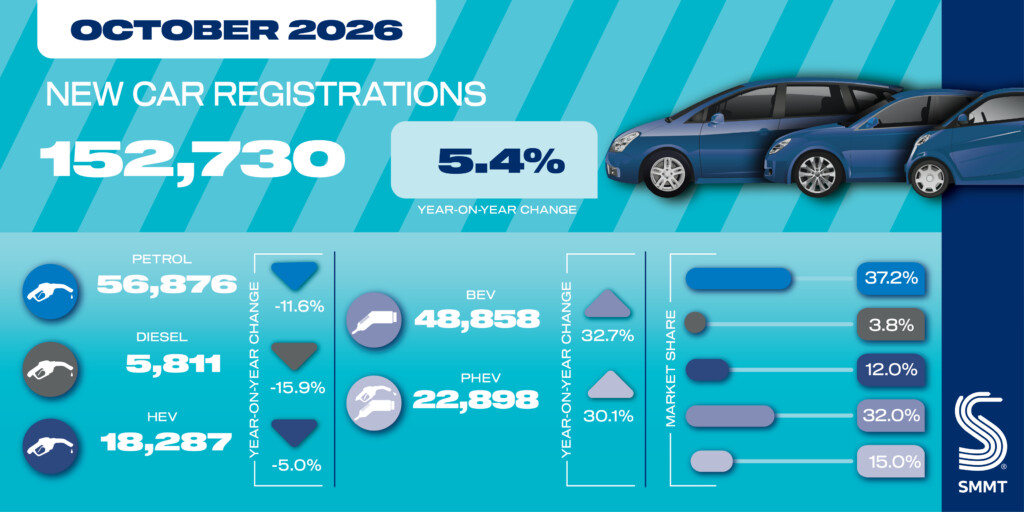
The headline number holds up. The Society of Motor Manufacturers and Traders (SMMT), the UK car industry's own trade body, reported 152,730 new car registrations in October 2026, up 5.4 percent on October 2025. Of those, 48,858 were battery electric, up 32.7 percent year on year, giving BEVs a 32.0 percent market share, their highest monthly share of the year. A separate independent count from New AutoMotive put BEV registrations slightly higher at 49,155, a 31.8 percent share, landing in the same range as SMMT's own number. "One in three" (33.3 percent) rounds up a touch generously from 32 percent, which is why SMMT's own chief executive, Mike Hawes, described it more precisely as "almost one in three."
What the "win" framing leaves out. SMMT's release is not a victory lap. The same numbers show October's 32.0 percent share is still short of the UK government's ZEV Mandate target of 33 percent for 2026, and the year-to-date share for January to October sits at just 26.6 percent, well off that pace. Hawes put it bluntly: "Higher targets may force supply, but they do not create demand," adding that October's share was "great progress in the transition, but one that comes at enormous cost" (a reference to the discounting manufacturers are using to hit their mandated EV sales quotas rather than pure consumer demand doing the work).
The gap SMMT says is about to get worse. SMMT's own forecasts show the shortfall widening, not closing: a forecast 27.2 percent BEV share for all of 2026 against the 33 percent target, then 32 percent forecast against a 38 percent target in 2027, and 37.5 percent forecast against a 52 percent target in 2028, a 14.5 percentage point gap SMMT says is "more than double this year's shortfall." That squeeze arrives as new EV-specific taxes, including road pricing (eVED) from 2028 and VAT on public charging, start to bite, both of which SMMT has criticised in the same release.
The bottom line: the "one in three" claim checks out closely enough, SMMT's own 32.0 percent and New AutoMotive's 31.8 percent both back it up, even if it rounds a few tenths of a percent generously. What's missing from the simple good-news framing is the context SMMT itself is pushing hardest: this is a mandate-driven market still running behind its own targets, propped up by manufacturer discounting, with a bigger gap to close in the years immediately ahead.