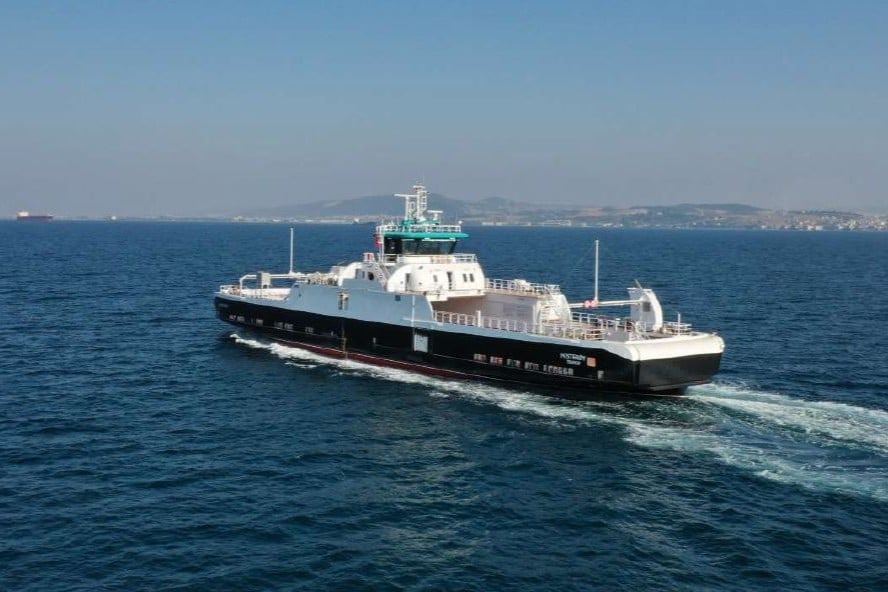
Norwegian ferry operator Torghatten Nord has taken delivery of Misterøy, a new double-ended Ro-Pax ferry built by Özata Shipyard in Turkey, and several outlets reported it simply as an "electric ferry" or even "all-electric." That's not wrong exactly, but it's not the whole machine either. Misterøy is genuinely capable of running on battery power alone, and it also has two diesel generators on board for when it needs them.
What's actually on the ferry. Misterøy is about 77 metres long, carries 60 cars and 195 passengers, and is fitted with an Akasol battery system rated at 1,960 kWh, which Torghatten Nord says can be expanded later if needed. Propulsion runs through two Schottel thruster units, one at the bow and one at the stern. So far, that's a straightforward battery-electric ferry. But the ship also carries two Volvo Penta D16 diesel generators, and according to a detailed vessel review from maritime trade outlet Baird Maritime, it can run in three different modes: fully on batteries, in hybrid mode with one or both generators topping up the batteries, or in plain diesel-electric mode.
Why the gap in the coverage matters. Baird Maritime's review notes that Özata Shipyard "has marketed the vessel as a fully electric ferry," and several headlines, including an earlier piece from the same outlet, called it "all-electric" without mentioning the generators at all. electrive.com's report of the delivery, by contrast, names the Volvo Penta generators and all three operating modes directly. Both accounts agree on the ship's size, capacity and battery figures, so this isn't a case of conflicting facts. It's a case of some coverage quietly dropping the backup diesel plant out of the story.
The context that's missing isn't necessarily a problem for the ferry. Carrying diesel generators as backup is a common, sensible design choice for a fjord-crossing ferry that can't risk being stranded mid-channel on a flat battery, especially while the shore charging infrastructure at Festvåg, built around automated towers from Zinus, is still new. Misterøy is the first of three identical ferries Özata is building for Torghatten Nord's ten-year contract on the Festvåg-Misten crossing near Bodø, with sister ships Fløytind and Møysalen to follow, the last due in 2028. Running mostly on battery power with diesel as a safety net is still a big step up from a ferry that burns diesel the whole way across.
The bottom line: Misterøy really can and reportedly will run its crossing on batteries alone, so calling it an electric ferry isn't false. But calling it "fully electric" or "all-electric," as some coverage did, skips over two diesel generators sitting on board as backup. That's a "partly true" label: real battery power, with a combustion safety net left out of the headline.