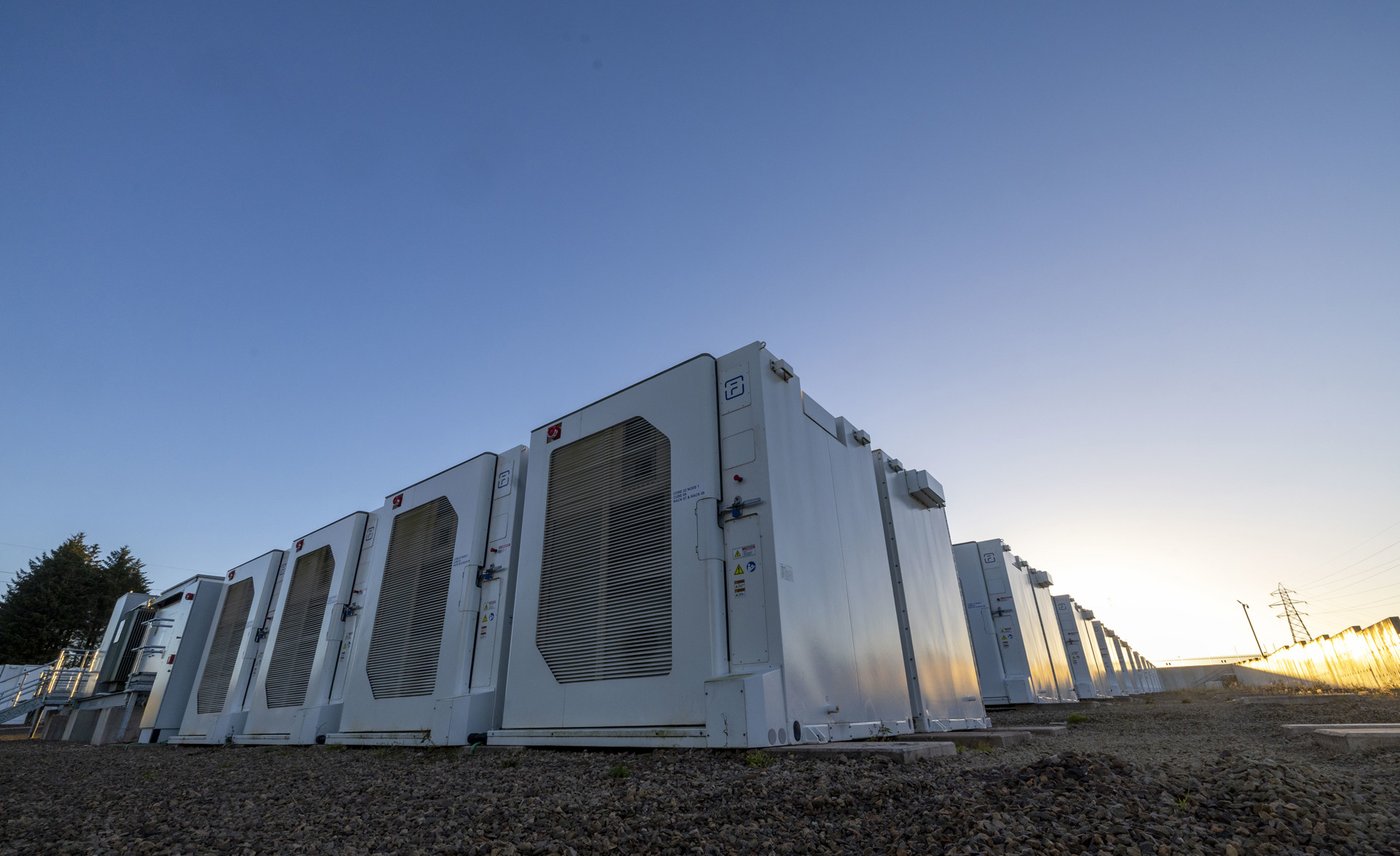
Norwegian energy company Statkraft says it has switched on "its first grid-forming battery project" in the UK: a 50 megawatt battery energy storage system (BESS) at Neilston Greener Grid Park, near Paisley in Scotland, officially opened on 12 November 2026. The claim worth checking isn't whether the battery exists, it clearly does, it's whether "first" means what it sounds like, and whether a 50MW battery is the big deal the press release makes it out to be.
What "grid-forming" actually means. Old-school power stations, coal, gas and hydro alike, keep the grid stable almost by accident: their huge spinning turbines store rotational energy, which smooths out sudden changes in supply or demand. As those plants close and more wind and solar connect, something else has to do that job. Most grid batteries so far have been "grid-following," meaning they just react to whatever voltage and frequency the rest of the grid is already running at. A grid-forming battery can set its own voltage and frequency, acting as an electronic stand-in for a spinning turbine. That's a genuinely useful bit of kit as Britain's coal and gas fleet shrinks.
What checks out. The battery is real and it is operating. A photo from Statkraft's own opening ceremony shows staff holding a plaque reading "Neilston Greener Grid Park, officially opened on 12 November 2026," matching the press release date exactly. Independent trade outlet Solar Power Portal separately confirmed Statkraft had started commercial operations at this first 50MW phase. Statkraft's claim that it has invested more than £2 billion in UK renewables since entering the market in 2006, and that it has already paid out more than £50,000 to community groups near the site, are the company's own figures, but nothing about the core announcement looks invented or inflated.
What needs an asterisk. Statkraft's release doesn't claim a UK or world first outright, it says Neilston is "one of the first in the UK to enter commercial operation," which is a much softer claim than it might sound at a glance and suggests other grid-forming batteries are already running elsewhere in Britain. More importantly, Statkraft's own release never mentions that Scottish planners approved an expansion of the Neilston site to as much as 750 megawatts back in August 2025, a detail only reported by Solar Power Portal. The 50MW now operating is just the first slice of a project that could eventually be fifteen times bigger. Statkraft also has a second grid-forming battery under construction at Coylton in East Ayrshire, so Neilston is one part of a wider build-out rather than a standalone milestone.
The bottom line: this one's Partly True. Statkraft genuinely has switched on a working grid-forming battery in Scotland, and the core technology claim stacks up. But treat "first" as a company-level claim rather than a clear UK record, and don't mistake the 50MW now running for the finished project, there's up to 700MW more approved and still to come.