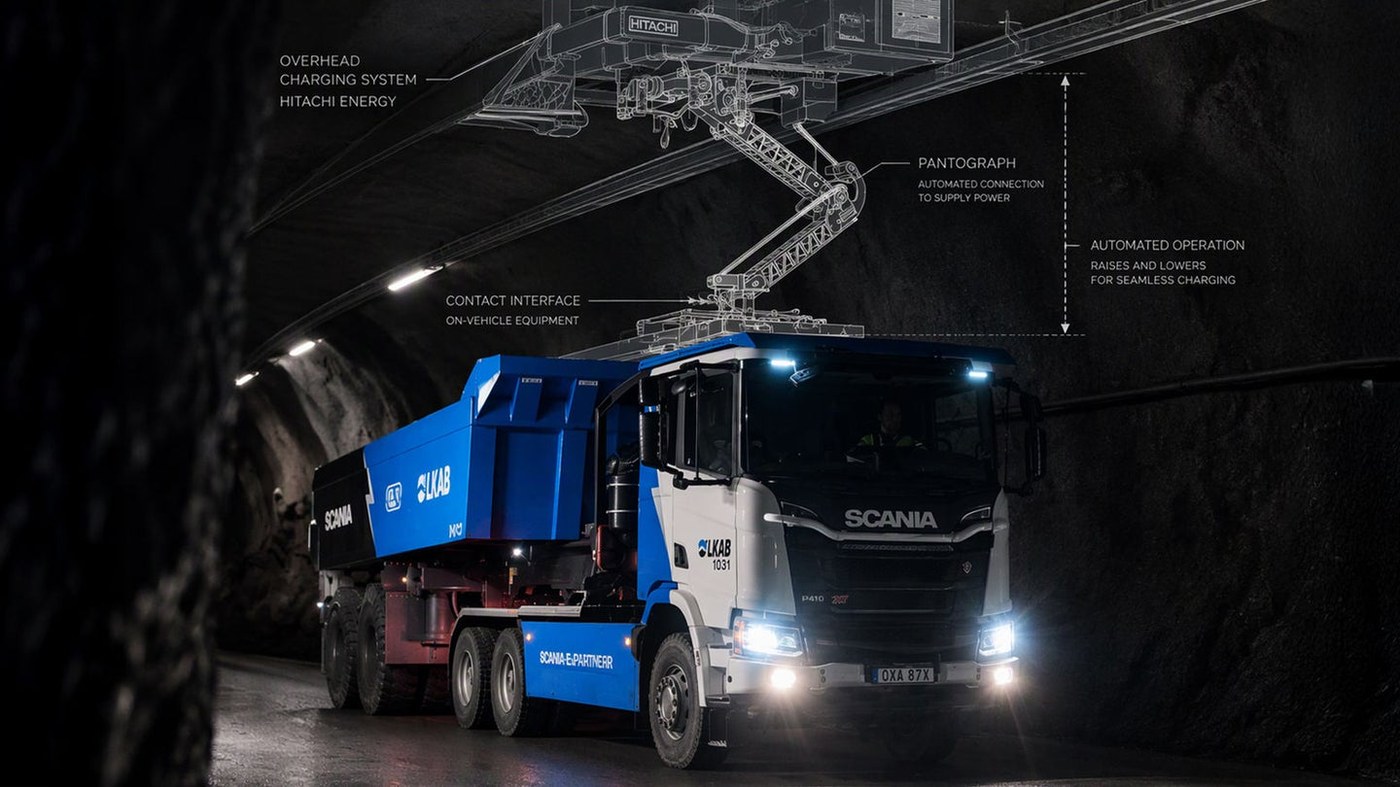
The pitch from three big industrial names, Hitachi Energy, Swedish state miner LKAB and truckmaker Scania, is that they've taken "the next step" in electrifying mining operations at Malmberget, one of the world's two biggest underground iron ore mines. It's a real project with real engineering behind it, confirmed in a joint press release and independent mining trade coverage. It's also, right now, a single truck being retrofitted, not a mine already running on electric haulage.
What's actually being built. The system is an automated pantograph charger, built on Hitachi Energy's existing Grid-eMotion Fleet technology, installed 1,250 metres below ground in the Malmberget mine. A fixed overhead arm lowers itself onto a contact point on the truck's roof and connects without a driver plugging anything in, delivering more than 400kW so the truck can top up "within minutes" during normal operational stops. That depth and power figure are repeated, word for word in substance, across both the companies' own release and independent reporting from mining trade outlet InvestMETS, so there's no sign of numbers being inflated in the retelling.
The part that's easy to miss. The headline framing, "next step in electrifying mining operations," reads like something already running. It isn't yet. The release is explicit that "the first truck is currently being adapted for the new charging system," meaning there is one vehicle, not a fleet, and commissioning is "planned for spring 2027," which is still more than a year off from publication. Hitachi Energy also calls Malmberget its own "first reference installation" for mining charging, which is a company milestone, not an industry first. No outlet we checked claimed otherwise, but a reader skimming just the headline could easily assume this mine is already diesel-free underground. It isn't, and nobody involved has claimed it is.
Who's who. LKAB operates the mine and is pursuing what its Malmberget manager, Magnus Abrahamsson, calls "a more electrified and automated mine." Hitachi Energy supplies the charging hardware and says, through Marco Berardi, head of its grid and power quality solutions business, that the project shows "how electric vehicles and automated high-power charging can be integrated into real underground operations." Scania's role is narrower than the headline trio implies: it's acting as what the company calls a "Pilot Partner," supplying and helping adapt the truck for real-world testing rather than selling a finished off-the-shelf product.
The bottom line: the technology, the depth, the charging power and the companies' roles all check out against independent coverage. The caveat is timing and scale, this is a single truck in a test phase with commissioning still over a year away, not an operating electrified fleet. Worth watching when that first truck actually goes live underground in 2027, but not yet the finished story the "next step" framing might suggest.