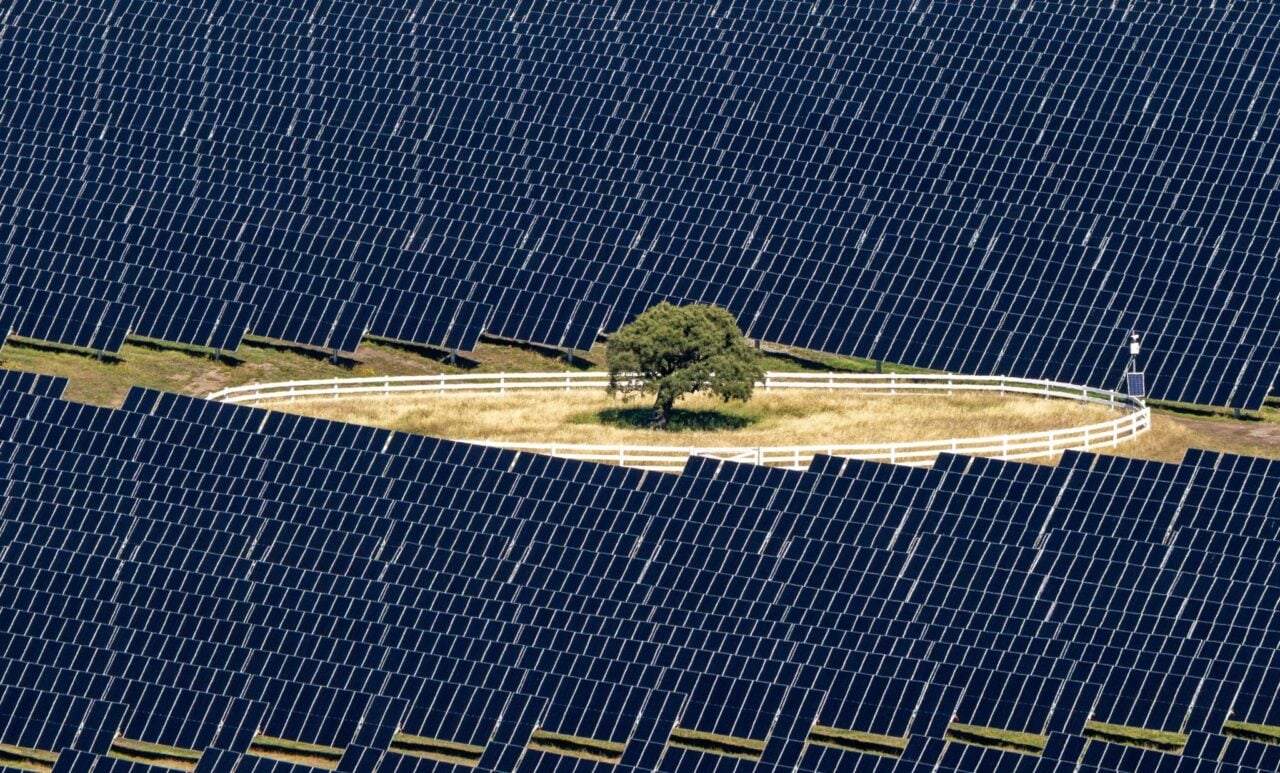
New Zealand's Prime Minister doesn't usually turn up to switch on a solar farm, so when Christopher Luxon opened the Kōwhai Park solar farm at Christchurch Airport in mid October, the project's backers were keen to point out it's now the South Island's biggest. That claim is true. Whether it's the record-setter some of the coverage implies is a bit more complicated.
What's actually been built. Kōwhai Park is a joint venture between New Zealand's Contact Energy and UK-based Lightsource bp (majority owned by oil major bp), built on 230 hectares beside the airport's runways. It's rated at 168MW DC (150MW AC) across roughly 300,000 panels, and cost about NZ$273 million, part-funded by NZ$267 million in green financing from Westpac New Zealand, Mizuho, China Construction Bank and Intesa Sanpaolo. Most of the output is already spoken for: Christchurch Airport and dairy processor Synlait have long-term power purchase agreements, with Synlait taking a quarter of generation for its Dunsandel and Dairyworks sites. Construction employed 235 people at peak and drew on 66 Canterbury businesses, with CHINTEC as the EPC contractor and Ventia building the grid connection into Orion New Zealand's network.
The "biggest" claim checks out, within its stated limit. The South Island's previous largest solar farm was the 63MWp Lauriston plant, also in Canterbury, so Kōwhai Park's 168MWp easily clears that bar. But it is not New Zealand's largest solar farm overall, and some headlines have been loose enough to blur that distinction. Harmony Energy's 202MWp Tauhei project in Waikato, on the North Island, was energised in July 2026 and holds the national title. Kōwhai Park is the country's second biggest, not its biggest, and the "South Island" qualifier matters.
The "36,000 homes" figure needs a caveat too. Kōwhai Park is projected to generate about 275 gigawatt-hours a year, which gets converted in coverage to "enough for roughly 36,000 homes." That's a standard industry calculation (annual output divided by average household electricity use), not a metered figure, and it glosses over the fact that most of the power is contracted to Synlait and the airport under those PPAs rather than sold to households directly. The number isn't fabricated, but it's a projection dressed up as a fact.
The bottom line: Kōwhai Park is real, it's operating under genuine commercial contracts, and the South Island record claim is accurate. It's a solid context point, too, that New Zealand's solar generation overtook coal for the first time in the June quarter of 2026, according to government MBIE data, independent of any single project's PR. But "South Island's biggest" is not the same as "New Zealand's biggest," and the homes-powered number is an estimate worth reading as one.