The claim doing the rounds in industry newsletters and on social media is that grid battery systems have gotten so much safer that failure rates have dropped 98 percent since 2018, the kind of number the renewable energy industry likes to wave at a nervous council weighing up a battery site down the road. The number is genuine. It comes from the Electric Power Research Institute (EPRI), the industry's own safety research body, in a report called "Risk Factors and Failure Statistics of Lithium-Ion BESS," released on 5 October 2026. It just needs some unpacking before it means what people think it means.
What EPRI actually measured. EPRI keeps a Battery Energy Storage System (BESS) Failure Incident Database going back to 2018, logging fires, explosions and other major thermal events with an internal cause. Normalised against how much storage capacity is actually deployed worldwide (failures per gigawatt-hour), that rate did fall 98 percent between 2018 and 2025, and 50 percent in the last year alone. EPRI now puts the annual failure rate for a typical storage container at between 0.04 and 0.14 percent, which it says is comparable to the long-run failure rate of oil-filled electrical transformers, a piece of equipment nobody loses sleep over. The regional numbers back it up: China's rate is down 99 percent, the US 97 percent, and Oceania recorded zero battery failures in 2025.
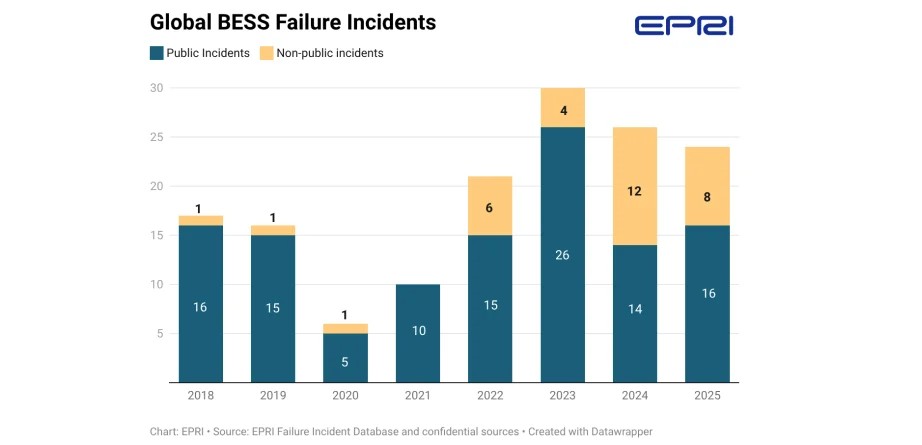
The first catch: it's a rate, not a falling count. The 98 percent figure collapsed mostly because the industry deployed so much more storage, not because incidents themselves disappeared. The world installed over 300 gigawatt-hours of new batteries in 2025 alone. The actual incident count barely moved: EPRI logged 26 failures in 2024 and 24 in 2025, essentially flat, while the fleet behind those numbers nearly doubled from 343 to 634 gigawatt-hours. The technology genuinely is getting safer per unit deployed. Fires and explosions are not vanishing in absolute terms, and EPRI flags that older, pre-2021 systems, which still make up about 3 percent of global capacity, fail at noticeably higher rates and need dedicated safety reviews or retrofits.
The second catch: EPRI says its own data has gaps. Of the 150 incidents in EPRI's database, 33 of them, 22 percent, are logged as "non-public": EPRI knows only the year and country, because there is no legal requirement in the US, Europe or most other markets to report a battery failure to anyone. In China, 22 of the 25 incidents EPRI counted are non-public. EPRI's own sensitivity analysis assumes the database is missing somewhere between a quarter and half of all incidents that actually happened, and the report itself calls "increased transparency from failures" necessary for the industry to keep improving.
The bottom line: this one's Partly True. Battery storage genuinely has become dramatically safer as the technology matured and newer systems replaced riskier early designs, and comparing it to transformer failure rates is a fair benchmark. But "failures fell 98 percent" is a rate calculation that makes a real, more modest improvement sound more dramatic than the raw incident numbers suggest, and it rests on a database its own authors say is missing a fifth to a half of what actually happened. Anyone using this figure to vouch for the safety of one specific project, rather than the industry as a whole, is stretching it further than EPRI does.