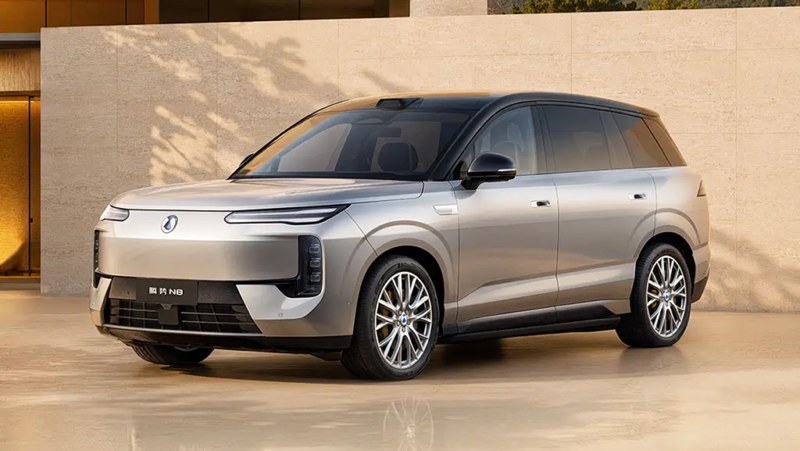
The claim: BYD's premium offshoot Denza says its new N8 electric SUV carries "a world-leading 1,003 km" of range on a single charge, and that number really is what's on file with China's own regulator. What gets left out when the figure travels outside China is which test produced it, and that test is widely regarded as the most generous range rating used by any major car market.
What's actually confirmed. Denza opened pre-orders for the N8 in China on 26 October 2026. The 1,003km figure applies to the version fitted with a 130.15 kWh Blade Battery 2.0 pack, matching filings with China's Ministry of Industry and Information Technology. A smaller 105.79 kWh pack is rated at 800km. Both numbers are measured on CLTC, the China Light-duty vehicle Test Cycle, the standard every new car sold in China is rated against. Pricing for the N8 itself hasn't been announced; its six-seat sibling, the N8L, starts around 299,800 RMB (roughly $45,000).
The test matters more than the number does. CLTC consistently rates vehicles higher than the cycles used elsewhere. InsideEVs' rule-of-thumb conversion puts CLTC figures at roughly 35 percent above the US EPA cycle, while WLTP, the cycle used across Europe, the UK, Australia and New Zealand, runs about 22 percent above EPA on its own. A separate estimate from New Zealand outlet Autotrader NZ puts CLTC at 15 to 25 percent above WLTP, which would land the N8's real-world range in the low 800km range rather than 1,003km. Neither conversion is an official, car-specific test result: no WLTP or EPA agency has independently tested the N8, so both figures are informed industry estimates, not certified ones.
Worth noting: 1,003km is also exactly the combined electric-only figure Denza quoted for the previous plug-in hybrid version of the N8. That doesn't make the new number wrong, but it's the kind of coincidence worth a second look rather than none.
The bottom line: the 1,003km claim is genuine and matches what BYD filed with Chinese regulators, so this isn't an invented figure. It's a CLTC number though, not a WLTP or EPA one, and every independent estimate of what that means for everyday driving outside China lands meaningfully lower, most likely in the high 700s to low 800s km. Read it as "very large battery, genuinely long range," not as "you'll see 1,003 actual kilometres."