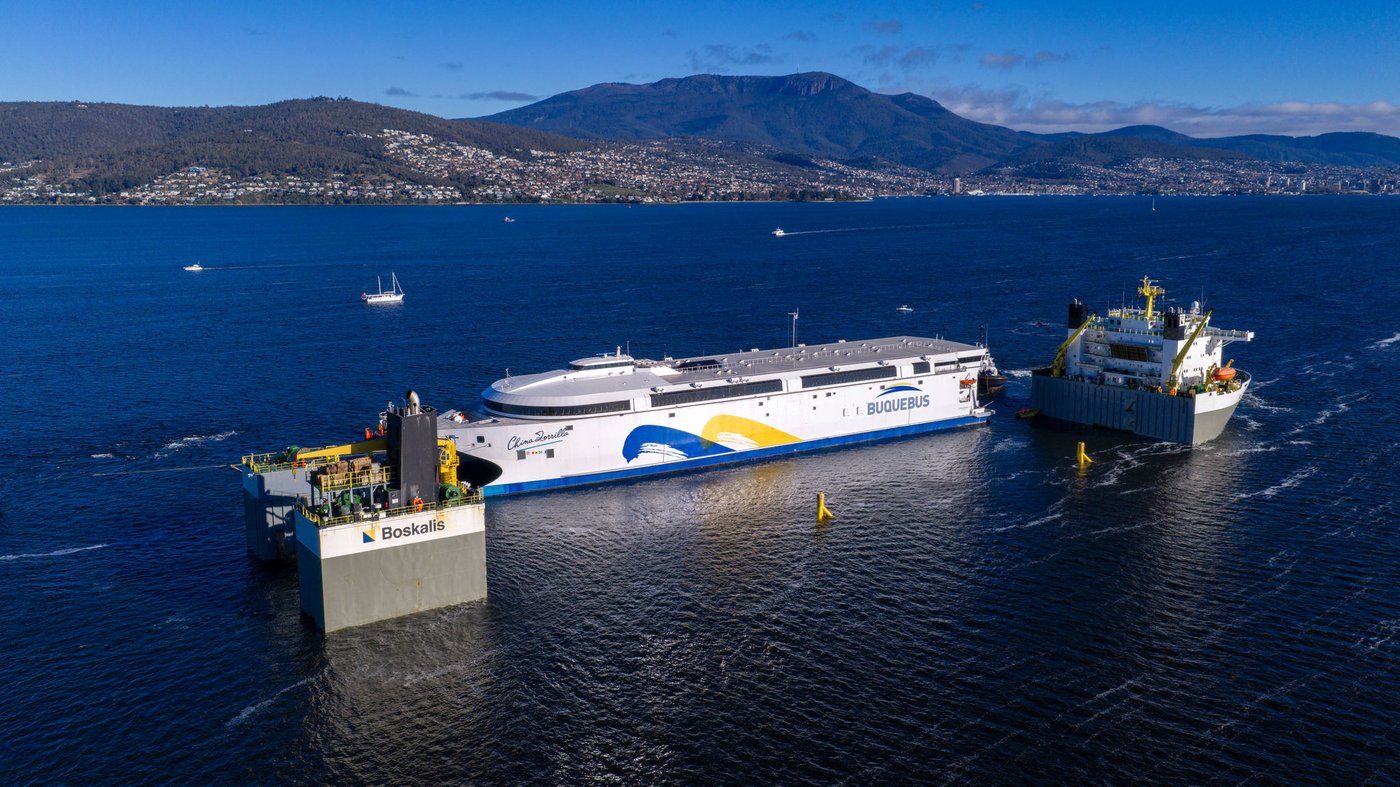
The claim going around this week: a ferry built in Tasmania and now carrying fare paying passengers between Buenos Aires and Colonia, Uruguay, is the "world's largest battery-electric ship" ever built. The ship itself checks out completely. The "largest" part rests entirely on the builder's own word.
What's real. The China Zorrilla is a genuine, enormous vessel: 130 metres long, built by Incat at its Hobart shipyard for the Argentine-Uruguayan operator Buquebus. It carries up to 2,100 passengers and 225 vehicles, with no diesel backup engine aboard, running on batteries alone. The energy storage system, a Corvus Energy Dolphin lithium-ion setup split across four insulated battery rooms, holds more than 40 megawatt-hours and weighs over 250 tonnes. Those figures show up the same way across Marine Log, New Atlas and the ship's own Wikipedia entry, not just in Incat's own press materials.
The timeline also holds up. The hull left Hobart in late July 2026, riding piggyback on the heavy-lift vessel Black Marlin for the roughly 40-day voyage to South America, since it's too big to make that crossing on its own charge. Incat held an official launch ceremony in Buenos Aires on 21 October, and says China Zorrilla has now completed its maiden commercial voyage on the Rio de la Plata crossing, a run of about 50 to 60 kilometres that normally takes 70 to 90 minutes.
What isn't verified is the "world's largest" title. Every outlet repeating it traces straight back to Incat's own announcements, which describe the battery system as "four times larger than any previous maritime installation" without naming what it's being compared against, by what measure (length, passenger count, battery capacity and battery weight would each give a different answer), or who checked. No classification society or independent maritime registry is cited confirming any ranking. It's also worth noting Incat is simultaneously building three similarly sized 129-metre battery-electric ferries for the Danish operator Molslinjen, so even Incat's own shipyard is turning out vessels in roughly the same size class.
The bottom line: none of this makes the ship fake or the achievement small. Building a car ferry that carries over 2,000 people entirely on battery power, on a genuine daily commercial route, is a real engineering feat whatever its ranking. But "world's largest" is marketing language from the company that built it, not an independently measured fact, so this one is Partly True: the ship and its specs check out, the superlative doesn't.