The claim going around this week is that electric trucks have "overtaken" diesel in trucking, pointing to China's heavy-truck market crossing the 50 percent mark. It's a real number from a real month, not a cherry-picked press release line. But the full picture is messier and more interesting than the headline suggests, and it doesn't travel well outside China.
The September number checks out. New-energy heavy trucks (12 tonnes and up) made up 50.3 percent of China's heavy-truck sales in September, or 33,100 units, up 37 percent year on year, while the overall heavy-truck market actually fell 21 percent. That figure comes from registration data compiled by First Commercial Vehicle Network and was independently reported before Electrek picked it up, so this isn't a single-source claim: two separate outlets, citing the same underlying registration data, land on the same 50.28 percent figure.
What the "first time" framing leaves out is how jumpy this number has been. New-energy heavy trucks were just 13.6 percent of China's sales in 2024. They nearly tripled in 2025 to a 28.9 percent share, then spiked to 53.9 percent in December 2025 as buyers rushed to beat the end of a trade-in subsidy and the start of a new purchase tax, then crashed back to about 23 percent by March 2026 once that rush passed. For the first nine months of 2026 the running share is 38.1 percent, not 50. September's 50.3 percent is a genuine high point, but it's sitting on top of a very bumpy line, not a smooth one-way climb.
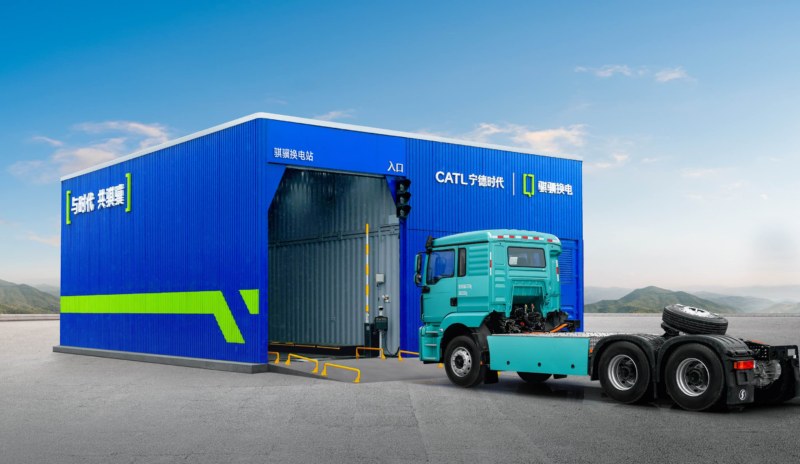
Why it's happening at all comes down to batteries you don't have to wait around for. CATL's Qiji network lets heavy trucks swap a depleted battery pack for a charged one in about five minutes, and CATL says it had roughly 300 of these swap stations running at the end of 2025, with plans for 900 by the end of 2026. In August, CATL paid about 2.56 billion yuan (roughly $370 million) for a near-25 percent stake in Qiyuan Green Power, which the reporting describes as China's largest heavy-truck swap operator. CATL's own claimed running-cost saving of about 0.6 yuan per km is the company's figure, not independently audited, but a separate academic study from the International Council on Clean Transportation and CATARC found battery-electric trucks about 19 percent cheaper per tonne-km than diesel under good conditions, with that advantage shrinking at low annual mileage or where the battery's weight eats into payload. Diesel is also losing ground to LNG trucks in China, which is a second, separate factor behind falling diesel demand there.
And outside China, none of this has happened yet. In the European Union, electrically chargeable trucks were 4.8 percent of new registrations in the first half of 2026, up from 3.6 percent a year earlier, which means diesel is still writing well over 90 percent of truck sales there. In the United States, there's no official electric Class 8 sales count, but with roughly 230,000 Class 8 trucks sold a year and electric volumes still in the low thousands, the share is well under 1 percent, and federal commercial EV tax credits lapsed in 2025 while California shelved its own zero-emission truck rule. China's swap-station model, built around standardised battery packs, doesn't have an equivalent anywhere else yet.
The bottom line: the 50.3 percent figure is real and independently confirmed, and diesel demand in China's heavy-truck fleet genuinely is falling as a result. But treating one strong month as proof that trucking has gone electric overstates it: China's own share has swung between 23 and 54 percent inside a single year, and in Europe and the US, diesel still is the heavy-truck market by a very wide margin. Partly true: the milestone is genuine, the "diesel's done" framing is not.