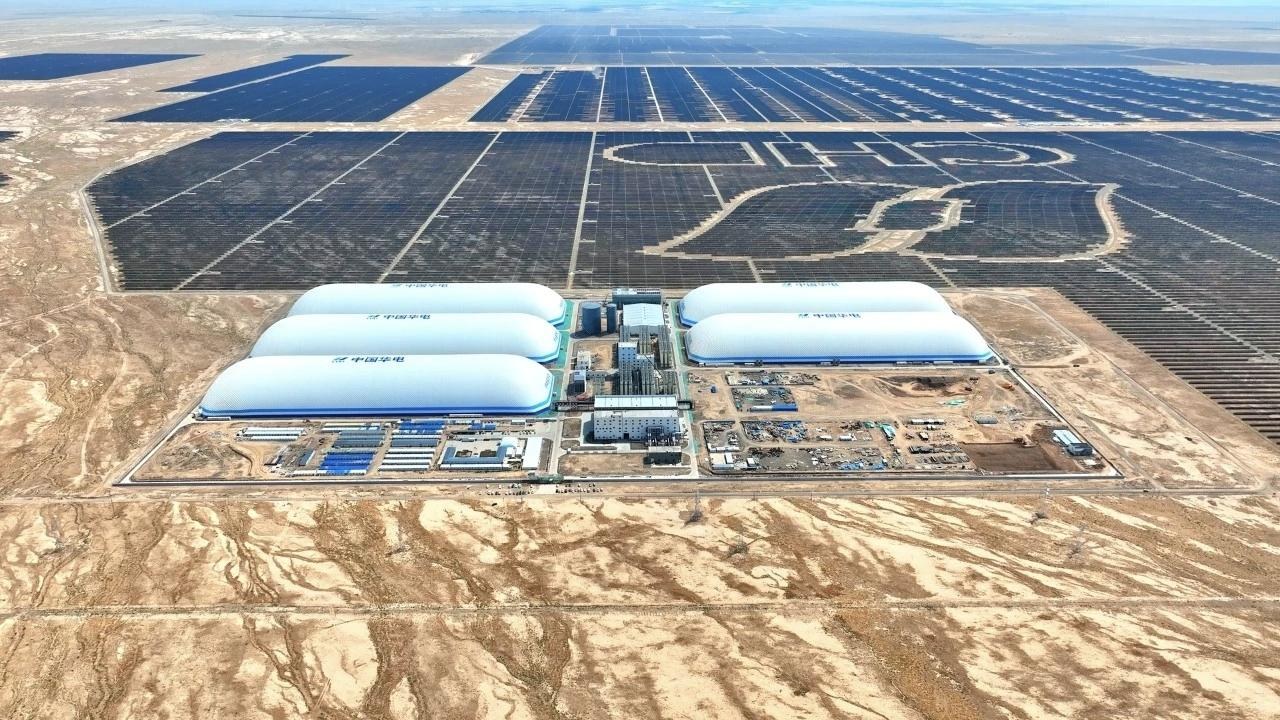
A post from People's Daily claimed China had connected its "first 100-megawatt-class" compressed carbon dioxide energy storage facility to the grid, able to store 290 million kWh of electricity in off-peak hours and release 180 million kWh at peak demand each year. Claims from Chinese state media about Chinese infrastructure get an extra round of checking on this desk, since the outlet reporting the story and the government that built it aren't independent of each other. So we went looking for technical coverage that didn't come straight from the same press release.
It's a real, named, locatable project. The facility sits in the Gobi Desert in Mulei County, Xinjiang, on about 565 acres of land next to a large solar farm. It's officially the Huadian-Dongfang Electric Mulei Compressed Carbon Dioxide Energy Storage Comprehensive Energy Demonstration Project, built by China Huadian Corporation (the state-owned power generator) with Dongfang Electric Corporation supplying the core turbine equipment under an EPC contract. Science and Technology Daily, a specialist government-run science outlet separate from People's Daily's newsroom, and Hong Kong's Bastille Post independently reported the same project, the same location and the same "first in China" framing.
The hardware numbers line up. Five gas storage tanks, 141 liquid storage units and 97 thermal storage units, reported identically across People's Daily, Science and Technology Daily and Bastille Post's coverage. The storage figures also match: about 290 million kWh stored during low-demand periods each year, about 180 million kWh released at peak demand. Projected annual generation is put at roughly 200 million kWh, a figure the original reporting doesn't fully reconcile against the 180 million kWh release number, so treat that particular gap as an open question rather than a confirmed fact.
How it actually works, and why it's not compressed air. The plant compresses carbon dioxide into a liquid when electricity is cheap and plentiful, then lets it expand back into a gas to spin turbines when demand peaks, the same basic idea as pumped hydro or compressed-air storage, but using sealed tanks instead of mountains or underground caverns. China has built several large compressed-air storage projects in recent years; this is a different technology aimed at sites without the right geology.
What's genuinely unverified: the superlatives. Project lead Ma Guojiang is quoted calling it "the most efficient carbon dioxide power generation unit in China today" and claiming turbine efficiency above 90 percent, more than 10 percent better than conventional thermal power. Those are the company's own performance claims, repeated by the government outlets covering the launch, not figures confirmed by an independent engineering body or grid operator. The projected savings of 50,000 tonnes of coal and 170,000 tonnes of CO2 emissions a year are similarly self-reported.
The bottom line: this one checks out on the facts that matter most, a real 100-megawatt-class compressed CO2 storage plant genuinely connected to the grid in Xinjiang, with consistent technical specifications across multiple outlets outside the original state media post. The efficiency and "most efficient in China" claims are the builder's own framing and haven't been independently verified, which is worth keeping in mind with any story like this one.