The claim going around trade press this week is that CATL, the world's biggest battery maker, has launched a new grid-scale battery in Australia that needs "up to 40% fewer containers" and shrinks project footprints by 12 percent, on top of signing real partnerships with a grid equipment maker, an engineering firm and a university. Big percentage claims from battery manufacturers are usually worth a second look. This one is a mixed bag: the launch and the partnerships are real and independently confirmed. The savings numbers are CATL's own marketing figures, and the comparison they're measured against is never named.
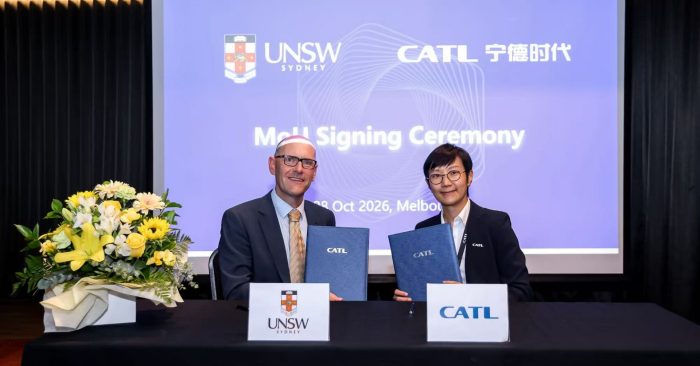
What's definitely real. CATL launched its new Tener+ system, a 9 megawatt-hour grid battery, at the All Energy Australia 2026 conference in Melbourne on 28 October. At the same event it signed a power conversion systems agreement with Hitachi Energy and a memorandum of understanding with engineering firm EPEC Group. It also signed an MoU with UNSW Sydney to help build a planned clean energy training centre in Western Sydney. UNSW's own newsroom confirms the signing, with a dated photo of UNSW Pro Vice-Chancellor Stephen Rodda and CATL Australia general manager Zane Zhou at the ceremony, independently of anything CATL itself put out.
What needs a second look. CATL says Tener+ needs "up to 40% fewer containers" and shrinks project footprints by "12%", but both figures are maximums measured against unnamed "conventional solutions", not any specific competing product or CATL's own previous model. It also advertises a 25-year design life and a "zero degradation" guarantee, but that guarantee only runs three years, and only on one configuration of the unit, not across the board. None of CATL's claimed efficiency or auxiliary power savings come with an actual number attached, just the words "improve" and "reduce".
Worth knowing: this is a pattern, not a one-off. CATL has form for leading with superlatives on this product line. Its original 2024 Tener was marketed as the "world's first" five-year zero degradation battery, and the 2025 Tener Stack was billed as the world's first 9MWh system, the same capacity Tener+ now carries. Company figures like "3,000-plus storage projects globally" and "17 gigawatt-hours installed in Australia" are self-reported and weren't independently checked for this article, though they're broadly in line with CATL's publicly reported scale as the market's largest supplier.
The bottom line: the Melbourne launch happened, the three partnerships are real and UNSW has confirmed its own involvement on the record. The specific savings numbers CATL is using to sell Tener+, the 40% fewer containers and the 12% smaller footprint, are the company's own figures against a baseline nobody has named, so treat them as a sales pitch rather than an independently verified result until a customer publishes real-world numbers.