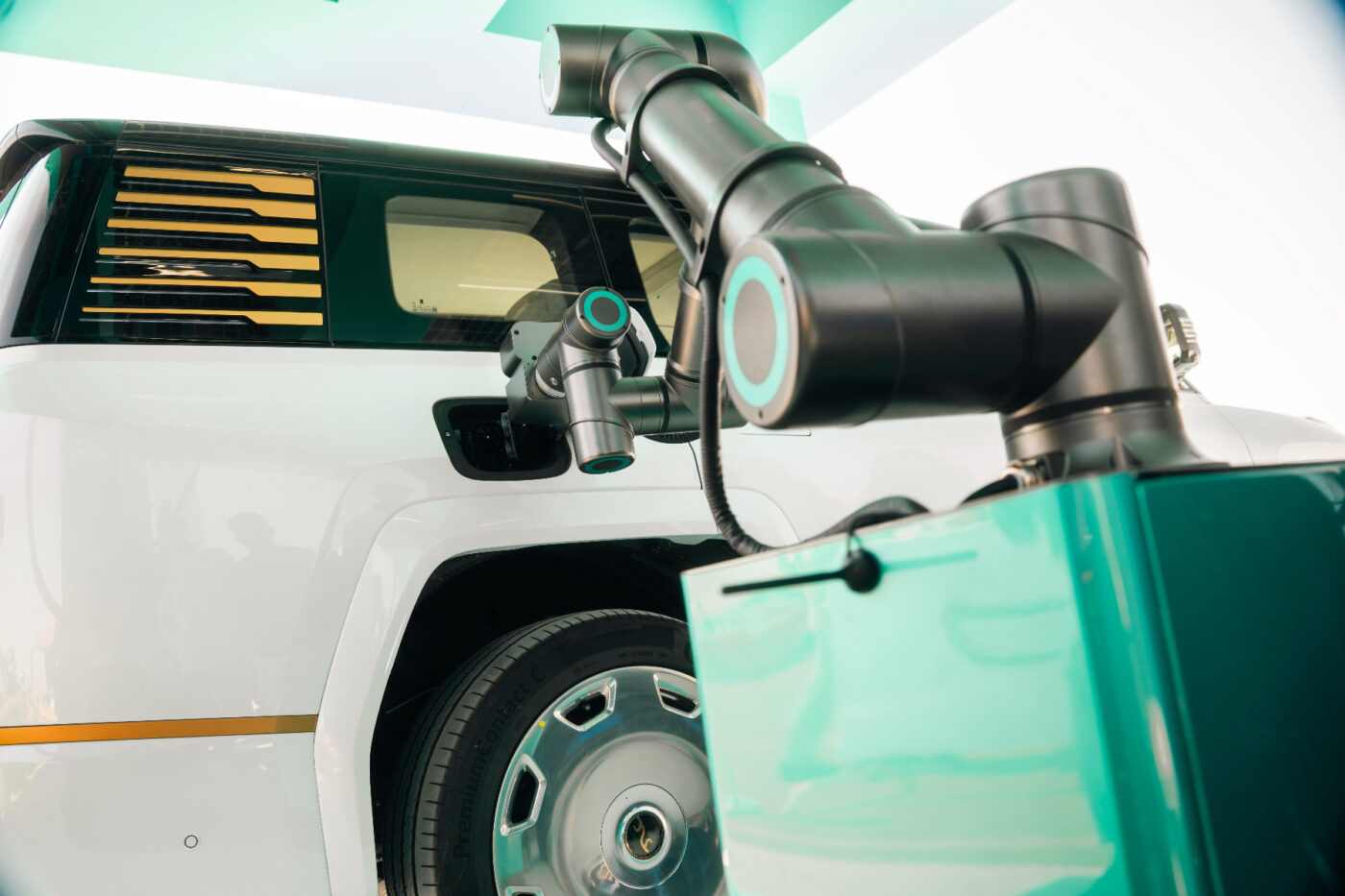
The video doing the rounds this week shows a mechanical arm swinging down over a parked BYD, popping open the charging flap, lining itself up and plugging in, all without a person touching it. It looks like a concept render. It isn't: BYD and its UAE distributor Al-Futtaim really did demonstrate this robot, live, at a "Flash Charging" showcase in the Abu Dhabi desert on 9 and 10 November 2026, and it was independently filmed and reported by electrive.com and Electrek, not just released as BYD's own marketing clip.
The charging numbers are real, but they're not a full charge. BYD and Al-Futtaim say the system can take a compatible car from 10 to 70 percent charge in five minutes, and from 10 to 97 percent in nine minutes, which is where the "400km in five minutes" headline comes from. Those are genuine figures from a 1,000-volt, roughly 1 megawatt charging platform, called the Super e-Platform. But batteries charge fastest in the middle of the range and slow right down near the top, which is exactly why the marketing always quotes the 10 to 70 percent window rather than 0 to 100. A full charge, start to finish, takes noticeably longer than five minutes, whatever the headline implies.
Nobody's said which cars actually get this speed. The megawatt figures only apply to "compatible vehicles" built on BYD's high-voltage Super e-Platform architecture. Al-Futtaim's own announcement says which models qualify is still "to be announced." That matters, because most EVs on the road, BYD's own included, aren't built for anywhere near 1,000 volts, and plugging one into a megawatt charger doesn't make it charge any faster than its own battery and onboard electronics allow.
The robot itself isn't a product yet. Electrive.com's report is explicit that the self-plugging arm is a demonstration, not something customers can currently use at a public charger. It's one showcase site in the desert outside Abu Dhabi, not a network rollout. Marketing material around the launch leans on "world's first" language, but Huawei showed a broadly similar robotic charging concept back in 2025, so the idea of a car that plugs itself in isn't entirely new, even if BYD's version is a step further along.
None of that makes this a beat-up. The arm is real, the footage is real, and the underlying megawatt charging tech is a genuine engineering achievement that outside outlets verified independently rather than just repeating BYD's press release. It's the gap between "it can do this" and "your car will do this, today, at a station near you" that the five-minute headline glosses over.