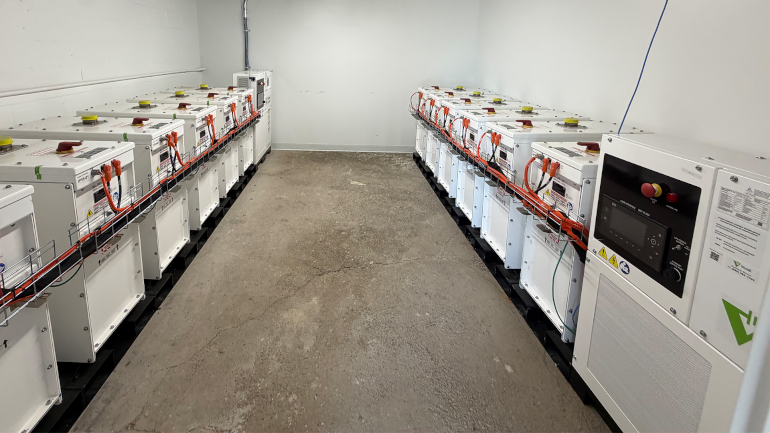
The pitch sounds like the kind of thing a battery company's marketing team would write: a battery big enough to run an entire apartment block for days, installed indoors, inside the building itself, with a straight face about safety. It's real. The Associated Press and Solar Power World both confirm the project, and the funding and safety details hold up when you go looking for them. Where the story gets softer is the "among the largest" claim, which comes from the companies involved rather than any outside ranking.
What's actually there. Viridi, a battery manufacturer with plants in Buffalo and Richmond, California, has installed a 3.75 megawatt-hour lithium-ion battery system across seven rooms inside Peace Bridge Place, a 105-unit affordable apartment building in Buffalo developed by Good Carbon Co. The building is fully electrified, using geothermal heating and cooling instead of gas, and renters earn no more than 80 percent of the area median income. The battery can reportedly keep the building running for several days during an outage, and in normal operation it stores cheap grid power and discharges it when demand or prices spike.
The funding is checkable, and it checks out. NYSERDA (the New York State Energy Research and Development Authority) helped fund the project through its Future Grid Challenge, part of its focus on disadvantaged communities. National Grid, the local utility, backs it through a demand-response pilot coordinated by EnergyHub's Edge DERMS platform: the building earns money for not drawing from the grid at peak times and for discharging back into it when needed, which is meant to flow through to lower costs for residents. Both NYSERDA president Doreen Harris and Viridi CEO Jon Williams are quoted on the record in the AP's coverage, and the broader policy context, Governor Kathy Hochul's push for this kind of "non-wires" grid solution in New York, matches public state priorities.
The safety claims have a paper trail too. Putting a battery that size indoors, in an occupied residential building, is only possible because Viridi says it met UL safety standards in April 2026 that allow indoor installation without extra fire suppression hardware. The AP reports Viridi spent six years and $10 million developing its fireproof battery enclosure, with half that cost going to batteries destroyed in testing, including a "cheesecloth test" where a forced battery failure didn't char the cloth covering it. Jigar Shah, a former US Department of Energy official quoted in the piece, says Viridi is the only company to consistently pass that kind of test. These are strong claims, but they're attributed to named people and a specific certification rather than left vague.
Where it gets soft: "among the largest." Both the AP and Solar Power World describe the system as likely one of the largest indoor lithium-ion battery installations in an occupied US residential building. That's a reasonable-sounding claim for a 3.75MWh system spread across seven rooms, but neither outlet, nor Viridi, nor Good Carbon, points to an independent registry or ranking that verifies it against every comparable project in the country. It's the kind of superlative that's very hard to disprove and just as hard to confirm, and in this case it traces back to the companies promoting the project rather than a third party who counted.
The bottom line: this is a genuine, well-documented project with real funding from a state energy agency and a real utility demand-response deal behind it, and the safety certification is a verifiable, named standard rather than a vague assurance. The only claim worth a caveat is the "among the largest" line, which is the companies' own framing and hasn't been independently checked against other projects.