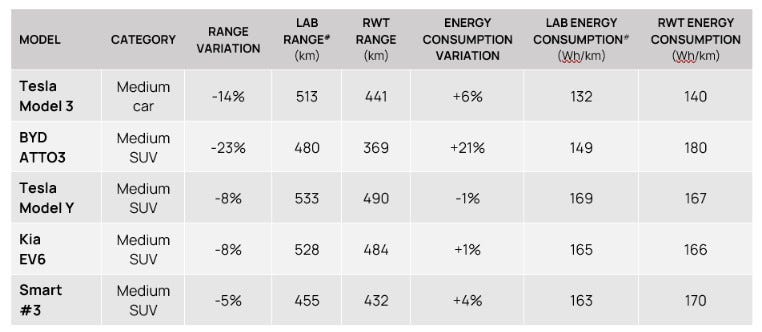
The Australian Automobile Association runs the country's only independent, government-funded real-world vehicle testing program, a $14 million initiative launched in 2023 in the wake of the Volkswagen diesel emissions scandal, specifically to check manufacturer claims against reality. Cars are driven on a 93km circuit around Geelong, Victoria, under standardised conditions, and their actual energy use and range are measured against what the manufacturer claims in the lab.
The EV results: real-world range came in 5 to 23 percent below manufacturer lab claims across the five EVs tested. The 2024 Smart #3 had the smallest gap, 432km achieved against a claimed 455km, a 5 percent shortfall. The 2023 BYD Atto 3 had the largest, 369km against a claimed 480km, a 23 percent shortfall. The Tesla Model 3 fell 14 percent short (441km vs 513km claimed), while the Tesla Model Y and Kia EV6 each came in 8 percent under their claims.
The context that changes the story: the AAA program has tested 114 petrol and hybrid vehicles under the same methodology, and 77 percent of them exceeded their advertised fuel consumption, meaning they used more fuel in the real world than the label promised. The gap in the EV results is real and worth knowing before you buy, range anxiety is the single biggest reason people hesitate on EVs, according to the same program's own research. But it's not an EV-specific problem. Every kind of vehicle's lab figures are optimistic compared to how people actually drive, and on this data, the petrol side of the fleet is missing its claims more often, not less.
The honest takeaway: if you're shopping for an EV, treat the claimed range as a ceiling, not a guarantee, and budget 10 to 20 percent under it for real trip planning. That's just sound practice, the same way nobody takes a tank-range sticker on a diesel ute at face value once they've driven it loaded, into a headwind, towing a trailer.